The DataSketches extension brings Apache DataSketches to DuckDB as SQL aggregates: approximate distinct counts, quantiles, frequent items, sampling and membership tests, each in a small mergeable sketch per group. The DuckDB 2.0 release of the extension changes what you can expect from those queries:
- They respect
memory_limit. Sketch memory is now DuckDB’s memory. It counts toward the limit, and DuckDB spills it to disk instead of letting it grow until the machine runs out. - Grouped queries are faster. With many groups and a 1 GB limit, sketch queries ran 1.3× (Density) to 4.7× (TDigest) faster, and four that never finished before now complete in under 20 seconds.
- Five new sketch families: Bloom filters, Count-Min, VarOpt and EBPPS weighted sampling, and Density, each with merge aggregates and scalar functions.
- Scalar functions are faster on repeated sketches. A function called on the same sketch row after row deserializes it once. Ranking a million values against one KLL sketch went from 6.6 seconds to under 0.1.
- Count-Min sketches are portable. A Count-Min sketch built on Linux used to give wrong estimates when read on macOS or Windows. It now gives the same answers everywhere.
Before and after
This query builds 2 million KLL sketches from 20 million rows, with a 1 GB limit:
SET threads = 8;SET memory_limit = '1GB';
SELECT count(s) FROM (  SELECT i % 2000000 AS g, datasketch_kll(200, v) AS s  FROM (SELECT i, ((i * 7919) % 1000003)::DOUBLE AS v FROM range(20000000) t(i))  GROUP BY g);
The previous release peaked at 39 GB. The TDigest version used 83 GB of the test machine’s 92 GB. We ran the same query for each sketch family on a 48-core aarch64 machine:
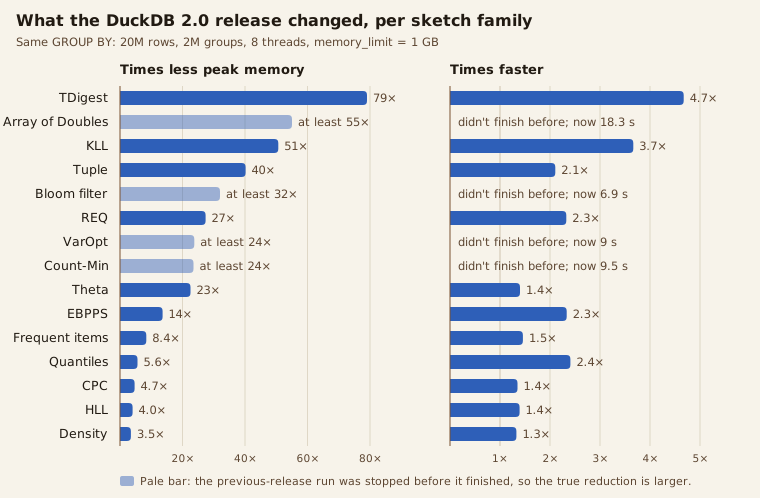
Peak memory sits at or near the limit, a little above it for some families, because the limit governs DuckDB’s buffer-managed memory, not every byte the process holds. Peak resident memory and wall time for each run:
| Sketch | Before | After |
|---|---|---|
| KLL | 39 GB, 22 s | 0.77 GB, 6.0 s |
| Quantiles | 4.3 GB, 17.1 s | 0.77 GB, 7.1 s |
| REQ | 29.3 GB, 21.4 s | 1.07 GB, 9.2 s |
| TDigest | 83 GB, 43 s | 1.05 GB, 9.2 s |
| HLL | 3.3 GB, 9.6 s | 0.82 GB, 6.9 s |
| CPC | 3.6 GB, 10.4 s | 0.77 GB, 7.7 s |
| Theta | 22.8 GB, 22.4 s | 1.01 GB, 16.0 s |
| Tuple | 43.4 GB, 33.9 s | 1.08 GB, 16.1 s |
| Array of Doubles | out of memory at a 60 GB cap | 1.09 GB, 18.3 s |
| Frequent items | 8.5 GB, 14 s | 1.01 GB, 9.6 s |
| VarOpt | over 24 GB (stopped) | 1.01 GB, 9 s |
| EBPPS | 13.9 GB, 21 s | 1.02 GB, 9 s |
| Bloom filter | over 24 GB (stopped) | 0.75 GB, 6.9 s |
| Count-Min | over 24 GB (stopped) | 1.02 GB, 9.5 s |
| Density | 3.9 GB, 10.1 s | 1.12 GB, 7.6 s |
We stopped some “before” runs early to protect the shared machine. Density reads its points from a table.
One limit remains: sketches whose items allocate memory of their own, such as KLL over VARCHAR, still keep their sketches on the heap. They work as before but don’t spill.
How the sketches moved into DuckDB’s memory
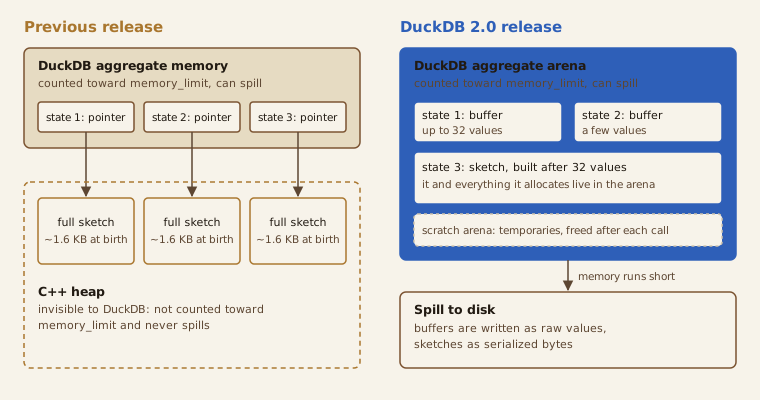
DuckDB 2.0 can spill an aggregate state only if the state lives in the aggregate’s arena, the memory DuckDB counts toward memory_limit; has no destructor; and can export itself to a value and import itself back. Our states were pointers to sketches on the C++ heap, freed by a destructor, so DuckDB could neither see nor spill them.
DataSketches lets each sketch take a custom allocator. We gave ours an arena mode that allocates from the running aggregate’s arena, so each state now holds its sketch, and everything the sketch allocates, in DuckDB’s memory, and exports as the sketch’s serialized bytes. Two details mattered. When DuckDB combines states from different threads, the source may sit in another thread’s arena that’s still in use, so a combine copies it rather than taking it over. And temporaries, such as an input sketch being merged, go to a short-lived scratch arena so they don’t accumulate in the state’s arena.
The bigger memory cost came from DuckDB itself. When a hash table isn’t reducing its input much, as with 2 million groups over 8 threads, DuckDB gives each row its own state and merges them later. A new KLL sketch reserves room for all 200 items up front, about 1.6 KB per row before any values arrive. States now start small: KLL buffers its first 32 values and builds a sketch only when more arrive, feeding them in their original order so the result is identical. HLL buffers 7 distinct values, CPC 16, and Theta, Bloom, Count-Min, VarOpt and EBPPS 32 inputs. A buffered state that spills is written as its raw values, not as a full-size sketch.
Heap sketches also got faster: they now use DuckDB’s allocator, which is jemalloc on Linux. That made grouped KLL queries up to 2.5× faster and TDigest up to 3.5×.
Fixes sent to Apache DataSketches
Relying on the library’s allocator support exposed eight problems in the DataSketches C++ library. We fixed each in our fork, with a test that fails without the fix, and sent it upstream:
| Upstream | Problem |
|---|---|
| #556 | An HLL union copied input sketches with the input’s allocator. |
| #557 | EBPPS’s merge(const&) called an unqualified swap, which doesn’t compile with an allocator from another namespace. |
| #558 | KLL reserved k items in its constructor. |
| #559 | Count-Min allocated its hash seeds with std::allocator. |
| #560 | Frequent items allocated a temporary array on every purge. |
| #561 | TDigest reserved about 10 KB of buffers up front. |
| #562 | Density’s kernel only accepted std::vector, and an unused allocator member was always default-constructed. |
| #555 | Count-Min’s hash seeds differed between C++ standard libraries. |
Until a DataSketches release includes these, the extension builds from the fork’s duckdb-5.3.0 branch: release 5.3.0 plus one commit per fix.
Two DuckDB issues worth knowing about
Benchmark aggregates from a table, not range(). In DuckDB 2.0, range() is read by a single thread while the aggregate still divides its memory budget across all threads, which makes aggregates spill when they don’t need to (#27749). Our early numbers showed a 3× slowdown at 200,000 groups for this reason. Read from a table, the KLL aggregate over 200,000 groups doesn’t spill at all and finishes in 0.52 seconds, ahead of DuckDB’s built-in approx_quantile at 1.50.
Some in-memory queries spill anyway. Even reading from a table, DuckDB’s own list() exported its states about 920 times on the same query, whatever the memory limit. The aggregate’s memory reservation stayed at its 270 MB minimum: a check on arena size exported states before DuckDB asked for more memory, and after that first export the reservation never grew. Requesting more memory first halved list()’s time. We reported it, with measurements and the experimental change, as duckdb/duckdb#28040.
The extension page documents the established sketch families. Until it covers the five new ones, their functions are shown in the extension’s tests. If a sketch query doesn’t behave as you expect, open an issue.