Summary. DuckDB is superb at being a database engine. But upgrading it can still break things: install a new DuckDB, run
INSTALL airport; LOAD airport;, and you may be told the extension is not available for your version — because each community extension is a separate binary that must be rebuilt for every engine release. Building the engine and distributing the software around it are different problems, and the distribution side has two: at an engine release the extensions aren’t built yet, and between releases it is unpredictable how long an extension update takes to ship. We argue — with data — that DuckDB’s extension catalogue is best treated as a distribution, the way Ubuntu is a distribution of Linux. Haybarn is that distribution for DuckDB — installable today withnpx haybarn@rcoruvx haybarn-cli— and the findings below measure what it delivers.
The argument in five points:
- Problem 1 — on an engine release, the extensions aren’t ready. A new version is announced when the engine ships, but every extension binary is locked to that version and must be rebuilt and re-published first — even a point release requires rebuilding the whole catalogue. Until it catches up, upgrading can mean
INSTALL/LOADerrors. - Problem 2 — between releases, extension updates land unpredictably. Independently of engine releases, fixes and new versions flow as pull requests to
duckdb/community-extensions; how long they take to merge and publish is rising and increasingly variable — so a service built on DuckDB cannot reliably tell customers when an update will reach them. - Haybarn builds the same extensions about 2.4× faster. On identical GitHub-hosted runners, it rebuilds the catalogue about 2.4× faster end-to-end than
duckdb/community-extensions— 3.1–3.4× on Windows-MinGW and WebAssembly, ~1.5× on macOS. The difference is in the build pipeline, not the hardware: a read-write, Cloudflare-backedvcpkgdependency cache, plus a fixed pre-built container on the Linux legs in place of an inline Docker rebuild. - The speed-up multiplies across the estate. One full-catalogue rebuild costs a measured 104 CI-hours on Haybarn versus a modeled 245 CI-hours at DuckDB build speed — roughly 58% less. At DuckDB’s cadence (~10 releases/year) that is on the order of 1,408 CI-hours a year.
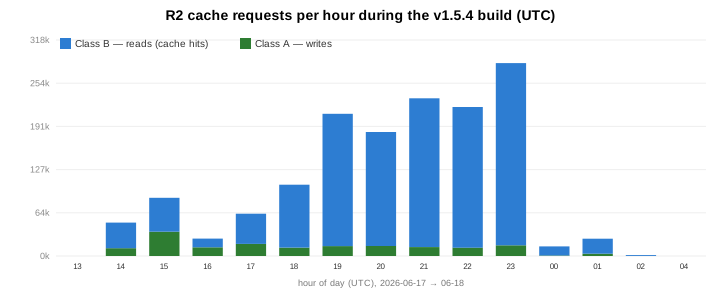
- The cache is cheap and demonstrably effective. During the v1.5.4 build it served 780,998 reads (Class B) against 51,035 writes (Class A) — a 15.3 : 1 ratio, peaking at 268,109 reads/hour. Cloudflare R2 charges nothing for egress; all-in cost is a dollar or two a month.
What Haybarn is, and why DuckDB needs a distribution
Haybarn is an independent, derived distribution of DuckDB published by Query Farm LLC. It is not affiliated with or endorsed by the DuckDB Foundation; DuckDB is a trademark of the DuckDB Foundation.
DuckDB ships two things that travel together but are built and released separately. The engine — the duckdb binary and its embedded libraries — is the equivalent of an operating-system kernel: a fast-moving core that defines an ABI. The community extensions — over 250 of them — are the packages: independently-authored capabilities (geospatial, formats, connectors, ML) that must be compiled against a specific engine version and distributed as per-platform binaries.
A new engine release does not carry its extensions with it. Every extension binary is keyed to the engine version it was built against; when the engine moves, the entire constellation must be re-compiled and re-published before users on the new version can install any of it. This is the same split Linux has between a kernel and a distribution. DuckDB Labs has solved the hard part — the engine — brilliantly; what is not yet solved is the binary distribution and devops around it: compiling, caching, testing, and publishing the entire extension catalogue for every release, on every platform. That is distribution work, and it is exactly what Ubuntu does for Linux — take a fast-moving core and ship a coherent, tested, fully-packaged system on top of it. Few organisations run a raw kernel in production; they run Ubuntu.
This is not a knock on the DuckDB team so much as a matter of scope and capacity. A focused core team has its hands full advancing the engine, and the long tail of commercial devops and packaging concerns is a different, open-ended job — one the engine roadmap should not have to absorb. Several of those concerns are already concrete:
- Distribution channels. The official catalogue is served from a single origin. Haybarn additionally serves extensions from Cloudflare’s global edge network and publishes them to npm (with PyPI planned), so they install through the package managers and CDNs teams already rely on — not a single point of distribution.
- Versioned history. The official catalogue exposes only the latest build of each extension: upgrade and you take whatever is current, with no way back. Haybarn keeps a full versioned history of every extension build, so an application can pin — and later reproduce — a specific older version instead of being forced to the latest.
- Predictable, reproducible builds. The fast, cache-backed, fixed-container pipeline described below rebuilds the whole catalogue for a new engine quickly and identically, closing the availability gap rather than living with it.
These are the everyday expectations of a distribution — multiple channels, version pinning, reproducible rebuilds — and they are exactly what commercial users need but do not yet get from the engine project alone.
Haybarn is a distribution of DuckDB, in the sense Ubuntu is a distribution of Linux. It tracks each engine release, rebuilds and tests the whole community-extension estate against it across the full platform matrix (Linux, macOS, Windows, WebAssembly; x64 and arm64), and publishes the binaries so that “upgrade the engine” and “all my extensions still work” become a single, consistent event rather than two events separated by an unpredictable gap of days. Crucially, on the Linux legs each build runs inside a fixed, pre-published container image rather than one rebuilt from scratch per job, so the toolchain is identical across the estate — reproducibility a distribution depends on, and, as we show below, a large source of its speed.
The packaging gap: engine release ≠ extensions available
When DuckDB announces a core release, the community-extension binaries for that version do not yet exist — they are produced afterwards, extension by extension, as each is rebuilt and deployed. That window can stretch from hours to days, and it applies to more than major versions: a point release requires rebuilding every extension too, so each patch must wait for the catalogue to be rebuilt before it is whole. During that window a user who upgrades on the strength of the announcement and then runs INSTALL airport; LOAD airport; can be told the extension is unavailable for their version. The engine works; the distribution is not yet ready. And because that window varies — sometimes hours, sometimes days — it is increasingly hard to predict when it will close, leaving both customers and the developers who serve them wondering when it is actually safe to upgrade.
This is a packaging-readiness problem, and other ecosystems solve it by convention. A Debian release is not declared stable until its package set is built and frozen; the kernel advancing upstream does not, by itself, push a release to users. DuckDB core advances on its own cadence — on the order of 10 releases a year (12 in the trailing twelve months), per the official release calendar — and community extensions are version-locked: each must be compiled against, and published for, the engine versions it targets. A release therefore is not fully usable until its extensions have been rebuilt and published. For commercial users, predictability — knowing that upgrading the engine will not silently break the extensions they depend on — is not a nicety but a precondition for adoption.
We are not arguing that core releases should block on the entire catalogue; doing so perfectly is genuinely hard. We are observing that the absence of any consistency window pushes the integration cost onto every user individually, and that a distribution is the natural place to absorb it.
Between engine releases, extension merge times are getting less predictable
The packaging gap above is most visible at engine-release time, but the underlying pipeline runs year-round: extensions don’t only change when DuckDB does — authors ship fixes and new versions continuously, each as a pull request to duckdb/community-extensions. The predictability of that everyday, inter-engine pipeline is what a commercial user ultimately depends on, and it is degrading. If you build services or products on DuckDB, that makes it harder to tell customers when an extension update will actually be distributed to them. We analysed every PR merged there in the trailing year (1,435 PRs; 1,027 of them extension release/version PRs — “add extension”, version bumps, and updates) and measured end-to-end time-to-merge (merged_at − created_at), bucketed by month.
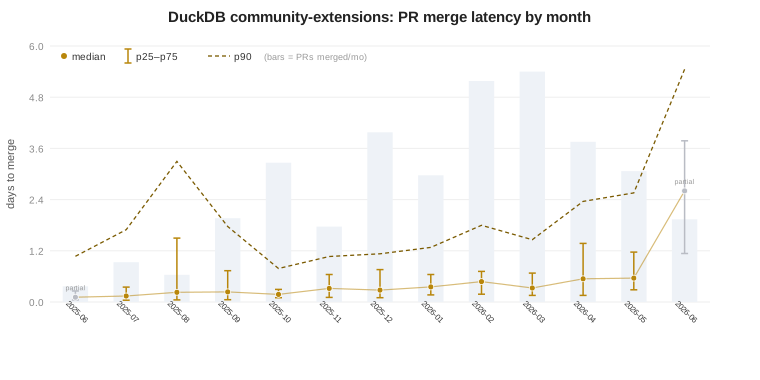
duckdb/community-extensions. Median (dot) with p25–p75 error bars and a dashed p90; pale bars are PRs merged that month. The first and last months are partial windows and are excluded from the trend read.To be clear, this is not a knock on the maintainers, who are notably responsive: for much of the year a typical PR merged within hours. The point is the trend. Across complete months, median time-to-merge rose from about 3.4 h (2025-07) to about 13.5 h (2026-05), with p90 widening from 40.8 h to 61.6 h, as monthly submission volume grew several-fold. (The partial June window, n = 79 and overlapping a release crunch, is set aside.) Note this is end-to-end latency — it includes author and CI round-trips, not only maintainer response-time — so it measures how long a version change takes to land overall.
The mechanism matters for consistency. Throughput here is ultimately bounded by maintainer attention, which is finite and batched into working hours and time zones. As submission volume keeps rising, when a version lands becomes harder to predict — and that unpredictability, more than any median, is what makes a consistent release experience hard to guarantee. It is also the front of the same pipeline whose tail end is the INSTALL/LOAD gap above: a version is not usable until it has merged, rebuilt, and published.
Where Haybarn helps — and where it stops today. Haybarn already removes the build-and-distribute half of this lag: once a change is in the catalogue, it is rebuilt and published across every platform in a fast, predictable window. The merge half is still upstream’s — today Haybarn tracks
duckdb/community-extensionsby syncing its contents, so an extension update reaches Haybarn only once it has merged upstream. Because a distribution is also the natural place to own the merge step, Haybarn is positioned to offer faster, predictable merges directly — decoupling a customer’s update timeline from upstream merge variance — though that is a future capability, not what it does today.
The build-time gap comes down to caching
Community extensions are mostly thin wrappers over heavy C/C++ libraries pulled in through vcpkg. The dominant cost of a build is therefore not compiling the extension — it is compiling those third-party dependencies. Whether that cost is paid depends almost entirely on the build cache, and this is where Haybarn and DuckDB differ by design.
DuckDB builds against a read-only cache. duckdb/community-extensions points vcpkg at the shared, read-only cache vcpkg-cache.duckdb.org. This is a sound default for a repository that builds untrusted pull requests: a read-only cache means a contributor’s PR can never poison the shared store, and it serves popular, already-populated dependencies well. Its limitation is that it cannot self-populate — on a miss (a new dependency, compiler, or triple) nothing is written back, so miss-prone targets like Windows-MinGW and the WebAssembly triples recompile the same dependencies from source on every run.
Haybarn builds against a read-write cache it operates. Query Farm rewired its extension-CI toolchain so that vcpkg’s binary cache (compiled dependencies) and asset cache (source tarballs) both point at a read-write store fronted by a Cloudflare Worker backed by R2 object storage. Reads are anonymous; writes are authenticated. A dependency is compiled once, written back on success, and reused by every later build across the whole estate. The asset cache additionally acts as a transparent mirror with origin fallback, so transient source-download outages no longer fail builds — improving build reliability alongside speed. (A ccache hashing fix for the WebAssembly toolchain compounds the effect.)
The result, measured on the same GitHub-hosted runner types via the same build.yml → _extension_distribution.yml matrix, is a per-platform speed-up that is largest exactly where the caching matters most. We compared 14 widely-used extensions built on both CIs, combining the Haybarn webhook-collector snapshot with timings pulled from the DuckDB GitHub Actions API.
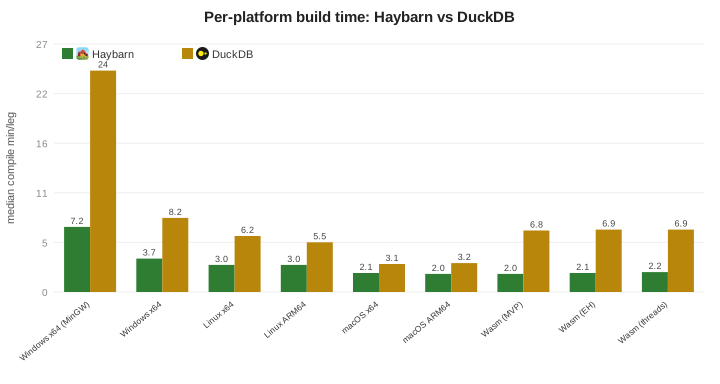
| Platform | Haybarn (min) | DuckDB (min) | Ratio (DuckDB ÷ HB) |
|---|---|---|---|
| Windows x64 (MinGW) | 7.2 | 24.5 | 3.4× |
| Windows x64 | 3.7 | 8.2 | 2.2× |
| Linux x64 | 3.0 | 6.2 | 2.1× |
| Linux ARM64 | 3.0 | 5.5 | 1.8× |
| macOS x64 | 2.1 | 3.1 | 1.5× |
| macOS ARM64 | 2.0 | 3.2 | 1.6× |
| Wasm (MVP) | 2.0 | 6.8 | 3.4× |
| Wasm (EH) | 2.1 | 6.9 | 3.3× |
| Wasm (threads) | 2.2 | 6.9 | 3.1× |
A full-catalogue rebuild is about 2.4× faster on Haybarn end-to-end, and the per-platform legs explain why: ratios range from ~1.5× on macOS to 3.1–3.4× on Windows-MinGW and the WebAssembly triples — the dependency-heavy, cache-miss-prone targets. That is the signature of a cache that is populated and reused versus one that cannot self-populate. It is not a hardware advantage — both run on standard GitHub-hosted runners — but a build-pipeline one: Haybarn operates a writable, estate-global dependency cache (and takes on authenticating its writes) where a public PR repository is, reasonably, limited to a read-only one.
Where the time goes: a5, step by step
Drilling into one extension makes the mechanism concrete. a5 is the floor case: a small Rust extension with almost no native dependencies, so the dependency cache saves little here and what remains is mostly fixed per-build overhead. The chart breaks its linux_amd64 leg into steps on both CIs.
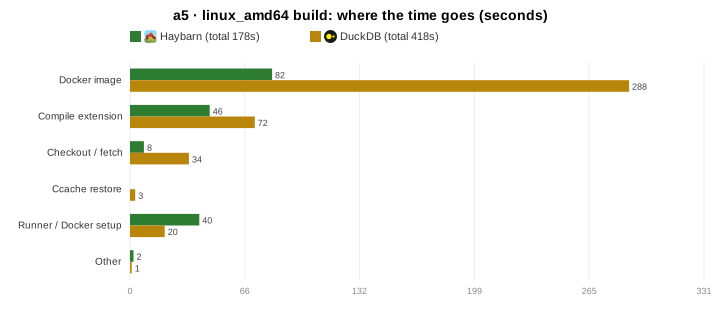
linux_amd64 build, seconds per step-group. The build-environment container dominates: rebuilt inline on the DuckDB Linux leg vs pulled pre-built on Haybarn.The single largest difference is the build-environment container. On its Linux legs DuckDB rebuilds the Docker image inline (288 s for a5); Haybarn pulls a pre-published image from GHCR (82 s) — saving about 3–4 minutes on this leg alone. Because that is pure fixed overhead, it is paid on every Linux leg of every extension; Haybarn’s CI notes estimate 5–8 minutes per leg for heavier images, on the order of 70 CI-hours across a 150-extension sweep. Even compiling a5 itself is 46 s versus 72 s — and this is the telling part: a5 has almost no dependencies, yet it still links against DuckDB core and its static libraries, which Haybarn reuses from cache rather than recompiling. A no-dependency extension already shows a gap; dependency-heavy extensions show far more.
Two engineering details enable this. First, Haybarn ships a newer ccache (4.13.6, versus 4.11.3 in the stock toolchain) specifically because older versions lack the bearer-token authentication needed to talk to a remote HTTP cache — without it, ccache cannot use a shared backend at all. Second, DuckDB’s compiler cache is GitHub Actions’ built-in actions/cache: per-repository, branch-scoped, and LRU-evicted around 10 GB, so it cannot share compiled objects effectively across hundreds of independent extension builds. Haybarn’s cache is global to the estate — an object compiled for one extension is available to every other. Together with the fixed container, this also makes builds more reliable: no per-run package/Docker-layer drift, and the asset-cache mirror removes a common class of transient download failures.
Multiplying across the estate
A per-extension speed-up is interesting; the estate-wide effect is the point. Of DuckDB’s roughly 250-extension catalogue, Haybarn rebuilt 210 in its v1.5.4-rc1 sweep; the 14 extensions above are the subset we could time on both CIs. Shipping the estate for a new engine version means rebuilding all of them, on every platform. We measured one such Haybarn sweep and modelled the DuckDB-equivalent cost by scaling each platform’s measured Haybarn compute by that platform’s observed ratio — a projection, not a second measurement.
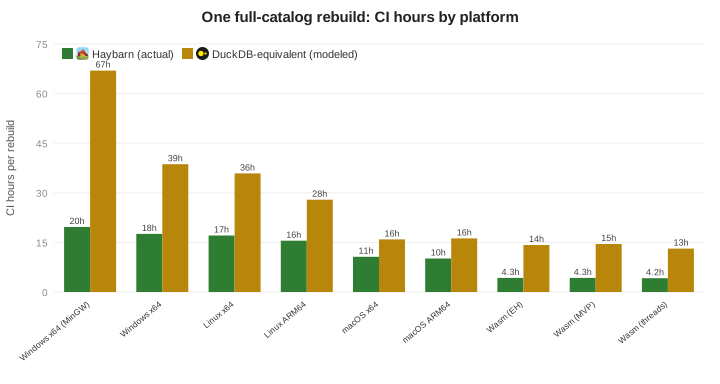
| Platform | Legs | Haybarn h | DuckDB-eq h | Ratio |
|---|---|---|---|---|
| Windows x64 (MinGW) | 128 | 19.8 | 67.4 | 3.4× |
| Windows x64 | 160 | 17.7 | 38.9 | 2.2× |
| Linux x64 | 202 | 17.2 | 36.1 | 2.1× |
| Linux ARM64 | 201 | 15.6 | 28.1 | 1.8× |
| macOS x64 | 189 | 10.7 | 16.0 | 1.5× |
| macOS ARM64 | 192 | 10.2 | 16.3 | 1.6× |
| Wasm (EH) | 122 | 4.3 | 14.3 | 3.3× |
| Wasm (MVP) | 121 | 4.3 | 14.6 | 3.4× |
| Wasm (threads) | 122 | 4.2 | 13.2 | 3.1× |
| Total | 104.0 | 244.9 |
That measured sweep cost 104 CI-hours on Haybarn. At DuckDB build speed the same sweep is a modelled 245 CI-hours (scaled from the per-platform ratios of 14 extensions; indicative) — roughly 58% more, or about 141 CI-hours per release. At DuckDB’s cadence (~10 releases/year) that is on the order of 1,408 CI-hours a year, and it grows with every extension added. Just as important as the total is the predictability: because cache hits dominate, build times are stable and failures from source-download flakiness are largely eliminated, so a full-estate rebuild lands in a known, short window. The faster and more reliably the estate builds, the shorter the packaging gap, and the more affordable it is to rebuild promptly and often.
Estate-completion latency compounds the same overheads. Both CIs run their platform legs in parallel — each waits only on matrix generation, not on the Linux leg — so the binding constraint is how quickly individual legs clear and how long they queue for scarce runners (macOS most acutely). Two things hurt here, and Haybarn fixes both: every leg pays its fixed container and setup cost before any useful compilation, so eliminating the inline Docker rebuild shortens the critical path of the whole sweep, not just its compute; and cache-warm legs finish sooner, returning runners to the shared pool and pulling the entire estate’s completion time forward.
The economics: shared concurrency, not dollars
It is tempting to say “CI compute isn’t free”, but for public repositories GitHub Actions is monetarily free. The real constraint is different and more binding: Actions concurrency is a fixed, shared pool per organization. Every job a full-catalogue rebuild queues competes with every other piece of work the org needs to run. A rebuild is one large, indivisible task — the engine release is not “done” until the last extension lands — so halving its compute means the org clears that task in roughly half the runner-time and frees concurrency for everything else sooner. Speed here buys throughput and a shorter packaging gap, which is exactly the resource that is scarce.
Against that, Haybarn’s marginal cost is strikingly small. The cache is an R2 bucket behind a Cloudflare Worker; it holds 75.68 GB, which at R2’s $0.015/GB-month is on the order of $1.14/month of storage at list price — and R2 charges nothing for egress, so the cache is read on every build with no bandwidth bill. A bounded object TTL keeps the bucket from growing without limit as triples and dependency versions churn. All in — storage plus the operations below — the cache costs about a dollar or two a month.
The read/write mix confirms the cache is working as intended. Over the v1.5.4 build window the bucket served 780,998 reads (Class B — GetObject + HeadObject) against 51,035 writes (Class A — PutObject and lists), a 15.3 : 1 ratio: dependencies are compiled and written once, then served from cache many times. The chart traces R2 requests per hour through that build, where reads peaked at 268,109 per hour while writes stayed flat — the cache absorbing the sweep almost entirely from already-compiled artifacts.
R2 bills Class B at $0.36/million and Class A at $4.50/million, so a read-dominated cache is also the inexpensive direction to be busy in.
There is a broader point: dependency caching may be the single highest-leverage use of object storage in this pipeline. Every extension build re-compiles DuckDB core and a stack of shared C/C++ libraries; storing those compiled artifacts once and serving them back trades a few dollars of storage for hundreds of runner-hours. The per-repository GitHub Actions cache cannot capture that value because it is not shared across extensions — which is exactly why the remote, estate-global cache pays for itself many times over.
The displaced compute also carries a small environmental cost — an estimated 7–76 kgCO₂e a year avoided, modest in absolute terms but scaling with the catalogue. The larger point is direction: efficient caching turns “rebuild everything for every release” from a cost that discourages frequent, consistent packaging into one cheap enough to do routinely.
Discussion
Three findings reinforce one conclusion. (1) Engine releases outpace extension availability, leaving a gap that surfaces to users as installation errors. (2) The PR pipeline that feeds extension releases is bounded by maintainer attention and shows rising, less-predictable latency as volume grows. (3) Rebuilding the whole estate is expensive without estate-global caching, which makes “just rebuild everything promptly” costly to do.
A distribution addresses all three at the point of integration rather than pushing them onto every user: it rebuilds and tests the whole catalogue against each engine release, fast and cheaply enough to do consistently, and presents a coherent “engine + extensions are jointly ready” moment. That is the role Haybarn fills. None of this is a criticism of DuckDB Labs, whose engine, public vcpkg cache, and CI tooling are what make a distribution possible in the first place — we build directly on them. We are not proposing that DuckDB gate its releases on the full catalogue; we are surfacing the gap, quantifying its cost, and noting that — as Ubuntu is for Linux — a distribution is the established way ecosystems give users a consistent experience. Where the techniques here are useful upstream — the read-write cache design, the pre-built build images, the ccache upgrade — we would be glad to contribute them back.
Try Haybarn
Haybarn’s distribution of the DuckDB community extensions is installable today:
npx haybarn@rc # oruvx haybarn-cliIt tracks each DuckDB engine release and ships the whole extension catalogue — rebuilt and tested across every platform. Source, issues, and the build tooling are public at github.com/Query-farm-haybarn; more at query.farm; and we welcome questions and collaboration at [email protected].
Methodology and data sources
- Haybarn build timings: a Cloudflare Durable Object that records every GitHub organization webhook for the Haybarn org, snapshotted locally to DuckDB. Per-job
started_at/completed_atcome from theworkflow_runsandworkflow_jobstables. - DuckDB build timings: the GitHub Actions REST API for
duckdb/community-extensions. For each comparison extension we mapped recent commits touchingextensions/<name>/description.ymlto theirbuild.ymlrun and read per-platform job durations. - Merge latency: every PR merged to
duckdb/community-extensionsin the trailing year, via the GitHub API; merge latency ismerged_at − created_at(an upper bound on pure maintainer wait, since it includes author and CI round-trips). - Caching / container / ccache architecture: read directly from
haybarn-extension-ci-toolsand the DuckDBextension-ci-toolsdefaults — the differences (read-only vs read-writevcpkgcache; inlinedocker buildvs pre-published GHCR image;actions/cacheccache vs remote HTTP cache; ccache 4.11.3 vs 4.13.6) are documented configuration differences, not inferences. - Cloudflare R2 metrics: the Cloudflare GraphQL Analytics API (
r2OperationsAdaptiveGroups) for thehaybarn-build-cachebucket, withactionTypemapped to R2’s Class A / Class B / free billing classes. Storage and pricing per R2 pricing ($0.015/GB-month; egress free). - Estate counterfactual: Haybarn’s full-catalogue rebuild compute is measured (the rc1 sweep). The “DuckDB-equivalent” is modelled by multiplying each platform’s measured Haybarn compute by that platform’s observed median slowdown ratio across the 14-extension comparison set — a like-for-like cost model, not an observed DuckDB sweep. Build/compile time excludes queue wait, which reflects each org’s CI concurrency contention rather than build speed.
Haybarn is an independent, derived distribution of DuckDB published by Query Farm LLC. Not affiliated with or endorsed by the DuckDB Foundation. DuckDB is a trademark of the DuckDB Foundation.